Dispatch to General Golz
For Whom the Bell TollsDispatch to General Golz is Robert Jordan’s urgent, sealed report on the conditions facing the planned offensive and the demolition of the bridge. Its importance lies in the gap between what the field can observe and what command can still change: Jordan tries to put the facts before Golz in time to affect the attack, even as the orders governing the bridge remain conditional and the message’s passage through the military system becomes uncertain.
Purpose and Operational Stakes
The dispatch takes shape around a strict sequence. Jordan had been told that the bridge must be blown only after the attack began, so that reinforcements could not come up the road before then. The timing was not a detail he could revise on his own: if the attack were called off, he was to blow nothing. The report therefore concerned more than the danger facing his small force. It might alter whether the larger operation went forward, while Jordan still had to preserve enough people to carry out the demolition if the attack did begin.
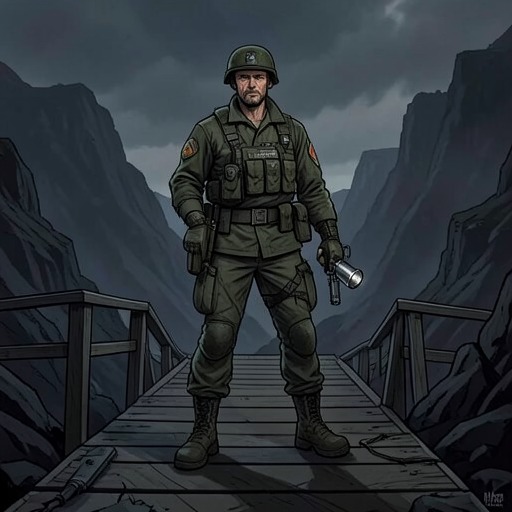
Jordan’s knowledge of the target came from close observation. The bridge was a single-span steel structure across a deep gorge, with a sentry box at each end and a road running through the pass below the forested slope. He sketched the structure and considered how to cut its support: either several charges placed carefully to act together, or two very large charges on opposite sides. The bridge’s geography made the task legible to an engineer, but the operation depended on timing and on the road remaining closed to reinforcements at the right moment.
The resources available were not simply a matter of Jordan’s calculations. El Sordo offered sixty sticks of common dynamite, without knowing their percentage, and the partisan defenses themselves required practical correction. Jordan pointed out that rocks meant to protect the flanks of a machine-gun position could instead shelter attackers, and that the gun needed a flat field of fire and a sideways angle. The report’s urgency thus belongs to a wider problem of preparation: intelligence, weapons, terrain, and orders all had to meet before the attack began.
Writing and Sending the Report
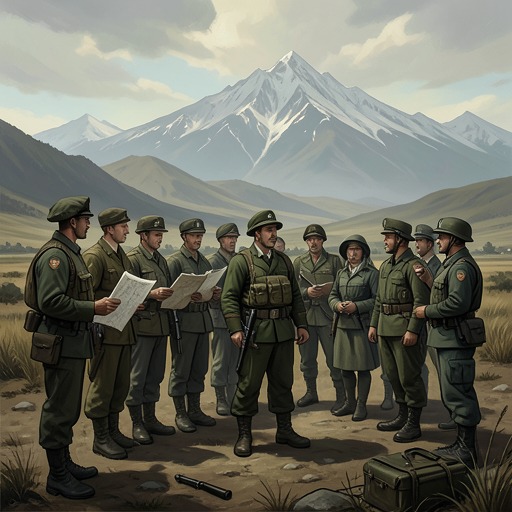
Jordan wrote that he would prepare a dispatch and send it by Andrés, explaining where Golz could be found at the Division’s headquarters. Anselmo was unsure how to translate that institutional description into a destination a messenger could use. He was accustomed to commands based in definite places, such as a house or the old hotel at Navacerrada; a headquarters chosen near the lines might instead be underground, in a cave or dugout, and could move with the needs of the command. Jordan explained that Andrés should ask for the General and for the Division’s headquarters, then show the written message to Golz, his chief of staff, or another authorized officer.
To help the dispatch pass, Jordan showed Anselmo a small, round, wooden-backed rubber stamp bearing the S.I.M. seal, with a tin-covered ink pad small enough to carry in a pocket. He planned to seal the message with it, expecting that the mark would be honored. The explanation reveals a practical divide between command’s terminology and the messenger’s experience: Anselmo understood places more readily than staffs and divisions, so Jordan had to make the route comprehensible before Andrés could set out.
Jordan’s writing was also an act of persuasion. He tried to make the report brief but convincing, and to present it as an honest account of the facts rather than an attempt to cancel the attack out of fear for his own mission. While Pablo told him that he trusted his judgment, Jordan was concentrating on the wording and barely listening. The praise did not resolve the problem the report was meant to address; it only sharpened the contrast between personal confidence and the uncertain authority to change an operation.
A Message Under Uncertainty
As he wrote, Jordan considered making two copies. A duplicate could make the warning safer, but preparing and delivering it would consume people needed to blow the bridge if the order remained in force. He also could not be sure what purpose the attack served. It might be a holding action, an attempt to draw troops away from another sector, or a means of drawing enemy planes north; he could not assume that the offensive was expected to succeed. His report had to warn command without pretending that he understood the whole strategic design.
The timing made that uncertainty consequential. Jordan’s orders were clear that the bridge was not to be blown until the attack started, and that he was to do nothing if it was called off. Yet the attack could not be canceled by Golz alone; permission had to come from Madrid. Jordan feared that the message might reach the capital too late, or that the people who needed to act could not be roused in time. He also recognized that he should have reported the preparations against the offensive sooner, but the enemy movement he wanted to describe had occurred only at dark, when it was less likely to be spotted by aircraft. The report was therefore an attempt to close a gap in knowledge that had opened only hours before.
The road itself was part of the intelligence problem. Anselmo, posted in a snowstorm, watched a camouflaged staff car pass below him and marked it on sheets torn from Jordan’s notebook. He counted ten cars going up that day, six going down, with four still up, but did not distinguish the ordinary vehicles of the division staff from the more imposing cars of the General Staff. The observation was careful and limited at once: Anselmo recorded movement, while Jordan would have understood the significance of differences among the vehicles. The dispatch depended on such unevenly distributed knowledge being carried to someone able to interpret it.
Delivery and the Limits of Command
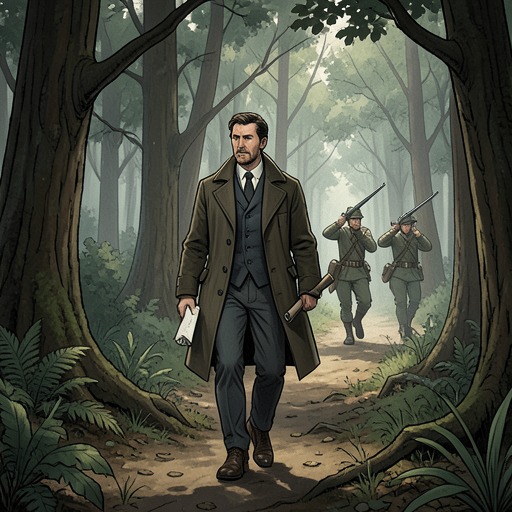
Jordan sealed four folded sheets of the dispatch with wax and the impression of the S.I.M. seal. Andrés carried them with a safe-conduct pass that Jordan had written from his notebook, giving Andrés’s name, age, height, birthplace, and mission. A small folded silk square displayed the Republic’s colors and another S.I.M. seal. At a post, the commander acknowledged the silk but insisted that possession of it proved nothing without the pass. The documents did not remove suspicion; they had to be inspected and authenticated before the messenger could proceed.
The delay was compounded by Andrés’s passage through wire and by an officer who urged the guerrillas to enter the Republican army and submit to its discipline. Andrés remained patient, but made the urgency plain: he had orders to deliver a dispatch to the General commanding the Thirty-Fifth Division, whose attack in the hills was due at daylight, and it was already late at night. He asked to be sent on toward Navacerrada with transport and an escort, rather than remain caught in an argument over the status of the guerrillas.
The dispatch’s trajectory is finally measured against the approaching operation. Andrés had been gone for three hours; the orders for morning had been given, and Jordan could only wait to learn whether word would arrive. The report embodies a genuine effort to make field conditions legible to command, but its sealed pages cannot by themselves overcome distance, competing authority, or the delay of transmission. As daylight approaches over the road and the bridge, the written plan remains exposed to the very conditions it was meant to change.